
Raziskava o trajnostnem certificiranju stanovanjskih stavb v Evropski uniji je prejela posebno uredniško priznanje mednarodne znanstvene revije Buildings.
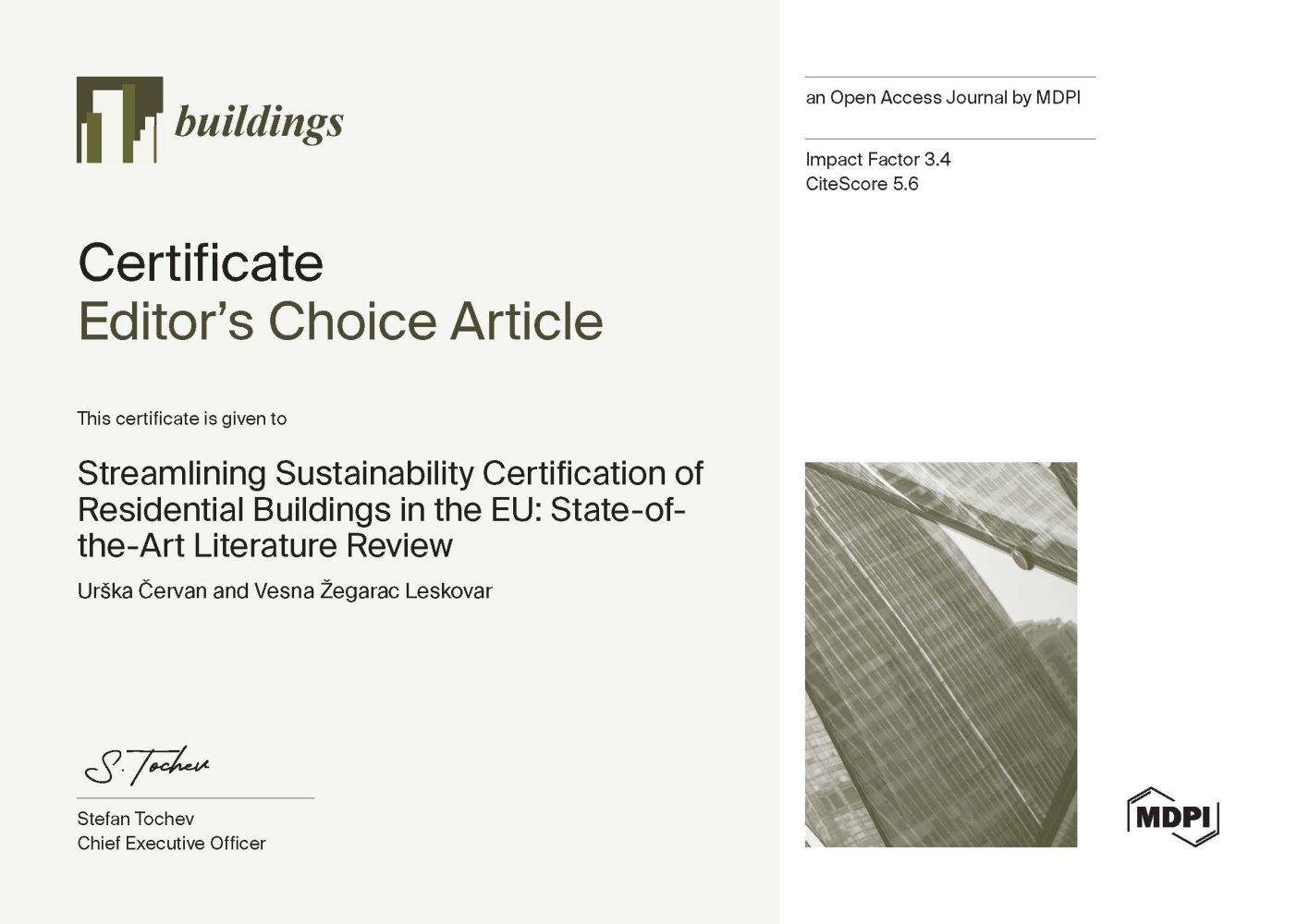
Pomembno mednarodno priznanje je prejel znanstveni članek»Streamlining Sustainability Certification of Residential Buildings in the EU: State-of-the-Art Literature Review«, katerega avtorici sta Vesna Žegarac Leskovar in Urška Červan. Uredništvo mednarodne znanstvene revije Buildings (MDPI) ga je uvrstilo med Editor’s Choice Articles, kar je priznanje, namenjeno raziskavam z izstopajočo znanstveno kakovostjo in aktualnostjo.
Članek obravnava področje trajnostnega certificiranja stanovanjskih stavb v Evropski uniji ter ponuja celovit pregled dosedanjih raziskav in praks. Avtorici v njem analizirata obstoječe pristope k ocenjevanju trajnostnosti stavb ter izpostavljata možnosti za poenostavitev certificiranja in učinkovitejšo uporabo sistemov vrednotenja.
O izboru je avtorice obvestilo uredništvo revije, ki je poudarilo, da je članek prejel oznako Editor’s Choice in tako postal del izbrane skupine prispevkov, ki jih revija posebej izpostavlja zaradi njihovega prispevka k razvoju znanstvenega področja. Avtoricama je bil ob tem podeljen tudi uradni certifikat.
Priznanje predstavlja dodatno mednarodno potrditev kakovosti raziskovalnega dela na področju trajnostne gradnje in arhitekture ter pomembno prispeva k prepoznavnosti raziskovalnih dosežkov UM FGPA v mednarodnem znanstvenem prostoru.
Članek je dostopen na spletni strani revije Buildings: https://www.mdpi.com/2075-5309/16/11/2115.
»The building sector is a critical component of the European Union’s strategy to achieve climate neutrality, as it accounts for 30–40% of total energy consumption and significant greenhouse gas emissions. While sustainability certification systems like BREEAM, LEED, DGNB, and HQE have established frameworks for environmental assessment, their widespread adoption in the residential sector faces challenges related to complexity and technical barriers. This paper provides a state-of-the-art literature review on streamlining sustainability certification for residential buildings in the EU. It examines the transition from established private schemes to harmonised frameworks such as Level(s), alongside the integration of Building Information Modelling (BIM) and Life Cycle Assessment (LCA). The review identifies key obstacles, including data interoperability issues, the need for automated quantity extraction, and the lack of technical expertise among stakeholders. Findings suggest that streamlining requires advancing semantic data models and digital twins to enable real-time performance monitoring and automated compliance checking. Furthermore, the alignment of national building codes with the Energy Performance of Buildings Directive (EPBD) and the European Green Deal is essential for fostering a more cohesive certification landscape. The study concludes by outlining pathways for reducing the administrative and technical burden of certification to support the EU’s decarbonisation and renovation goals.«